The Arctic Ocean may seem isolated and cut off from other oceans. Despite this impression, it is connected to the Pacific Ocean to the west and to the Atlantic Ocean to the south. Every year, less salty water from the Pacific enters the Arctic Ocean through the Nares Strait, the Nansen Strait, and other channels as far north as Baffin Bay. Pacific waters mix with other Arctic and Atlantic water masses, thereby altering their typical temperature and salinity. These mixtures make the oceanic signature (temperature and salinity) of Pacific waters difficult to recognize once they reach the Arctic Ocean.
To address this challenge, scientists have studied the fluorescence of colored dissolved organic matter (FCDOM) as an additional indicator for detecting Pacific waters in the Arctic Ocean. This organic matter, derived primarily from interactions between water and sediments in the shallow waters of the North Pacific, emits a measurable light signal. This signal acts as a kind of natural tracer, making it possible to track the path of Pacific waters even when their oceanic signature has changed.
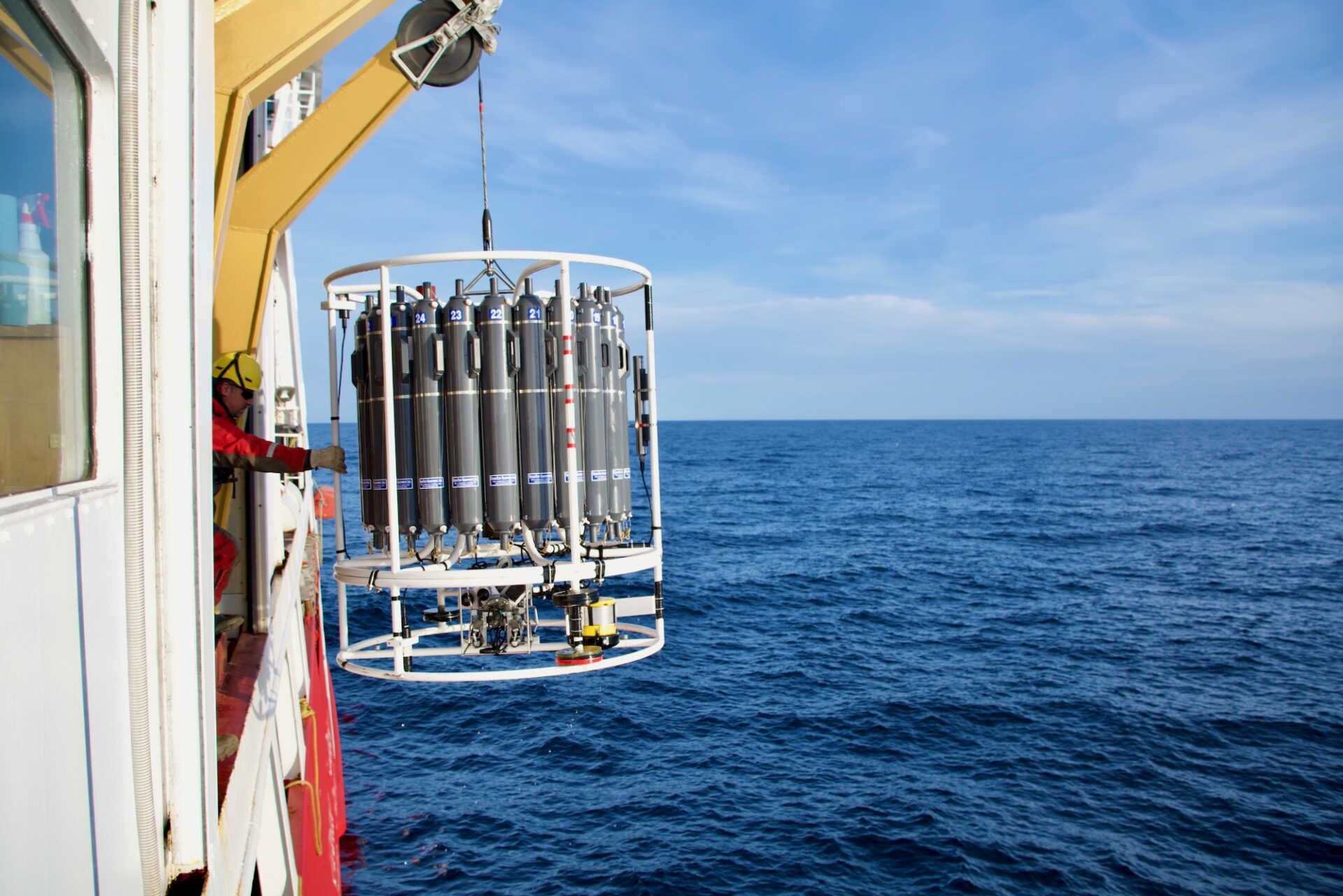
During the summer of 2024, Igor Dmitrenko and his team collected 40 ocean profiles (water temperature, salinity, and FCDOM) aboard the icebreakers NGCC Amundsen and NGCC Des Groseilliers. These profiles were taken in several key areas: northern Baffin Bay, Nares Strait, and the Nansen and Eureka Straits. The goal was to compare, for the first time, Pacific water flows through these different circulation routes.
By analyzing three layers of the water column, the scientists demonstrate that the FCDOM signal effectively tracks Pacific waters from the Arctic Ocean to Baffin Bay. However, the signature of dissolved organic matter in Pacific waters eventually fades, particularly when passing through certain shallow areas. The scientists also found that this signature disappears due to vertical mixing and interactions with Greenland waters in Baffin Bay.
Understanding the circulation of Pacific waters in the Arctic is essential, as these waters deliver nutrients that influence marine ecosystems. This study shows that FCDOM is an effective tool for tracking these water masses, even when their oceanographic properties change. It thus provides a better understanding of water masses exchanges in the Canadian Arctic Archipelago in the context of climate change.